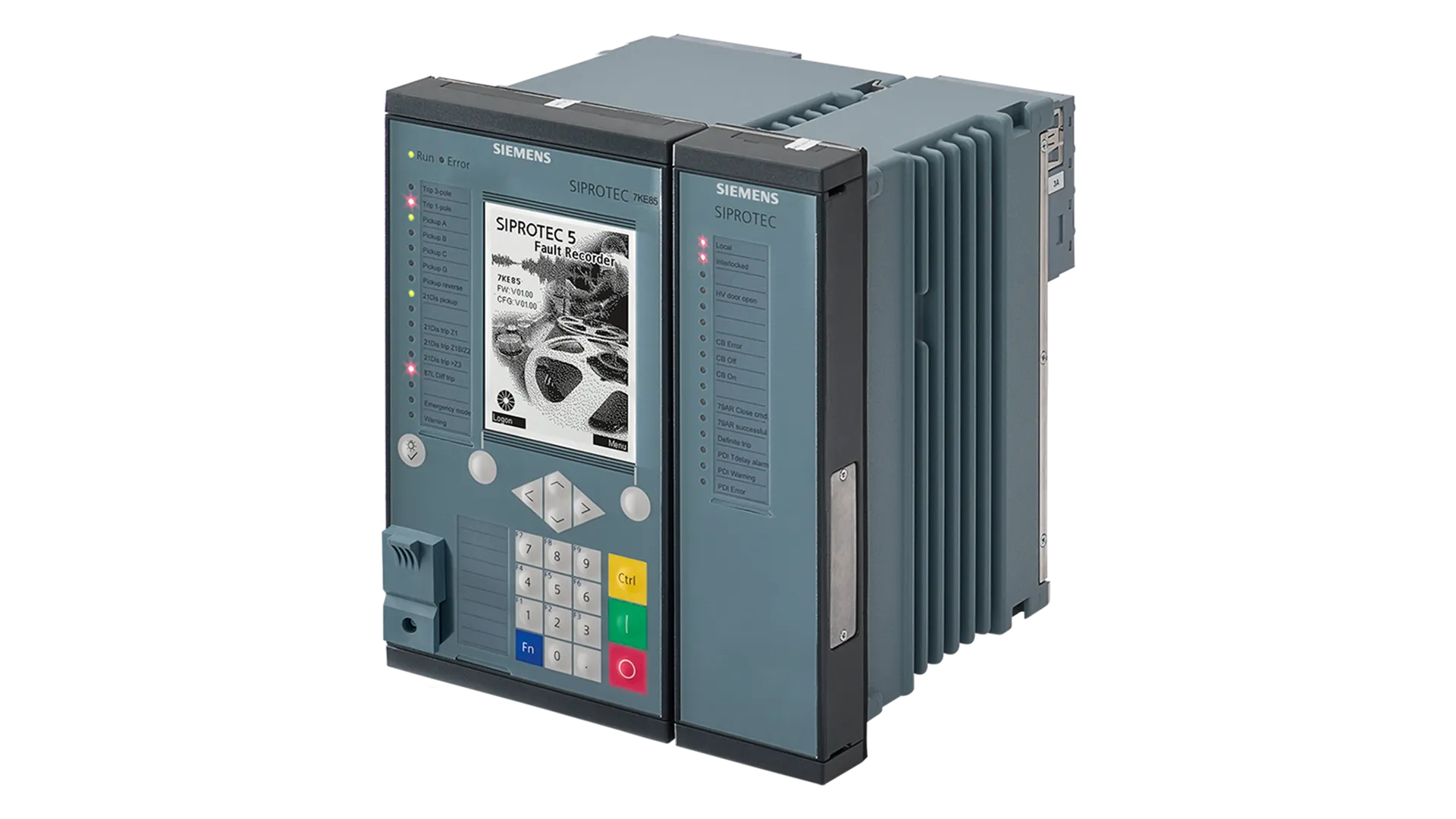
Fault recorder – SIPROTEC 7KE85
Fault recorder – SIPROTEC 7KE85
Powerful fault recorders with integrated measurement of synchrophasors (PMU) according to IEEE C37.118 and power quality measurement according to IEC 61000-4-30.
Main function:
Fault Recorder
Inputs and outputs:
- 4 predefined standard variants with up to 40 analog channels,
43 binary inputs,
33 binary outputs
Hardware flexibility:
- Flexibly adjustable and expandable I/O quantity structure within the scope of the SIPROTEC 5 modular system.
Housing width:
- 1/3 to 1/1 × 19"
As standard:
- Conformal coating
Functions
- DIGSI 5 permits all functions to be configured and combined as required.
- Up to 40 analog channels
- Fast-Scan Recorder
- Up to 2 slow-scan recorders
- Up to 5 continuous recorders and 2 trend recorders
- Power quality recordings according to IEC 61000-4-30
- Sequence-of-events recorder for continuous recording of binary status changes and IEC 61850 GOOSE messages
- Usable as Phasor Measurement Unit (PMU) according to IEEE C37.118 protocol
- Transmission of the records and triggering via IEC 61850 GOOSE messages
- Variable sampling frequencies parameterizable between 1 kHz and 16 kHz
- Distribution of the mass storage of 16 GB to the various recorders by the user as desired
- Intelligent monitoring routines of the storage medium ensure a high level of availability and completeness for the archived data
- Data compression without loss
- Time synchronization via Precision Time Protocol (PTP) IEEE 1588 protocol, IRIG-B, DCF77, and SNTP
- Routing of the measured values to the individual recorders as desired
- Combination of the measuring groups for the power calculation as desired
- Quality attributes for representing the instantaneous signal quality in the time signal view
- Trigger functions of a function block are fundamental component value, RMS value, zero-sequence, positive-sequence, negative-sequence system power, frequency power, Σ active power and Σ reactive power
- Level trigger and gradient trigger for every trigger function
- Flexible cross trigger and system trigger, manual trigger
- Creation of independent trigger functions with the graphic automation editor CFC (continuous function Chart)
- Trigger functions via a combination of single-point, doublepoint indications, analog values, binary signals, Boolean signals and GOOSE messages
- Consistent monitoring concept
- Auxiliary functions for easy tests and commissioning
- Special test mode for commissioning
- Fixed integrated electrical Ethernet RJ45 for DIGSI 5 and IEC 61850 (reporting and GOOSE)
- Data transmission via IEC 61850 of fault recordings in accordance with COMTRADE 2013, 1999 standard and continuous recording in accordance with IEEE Std 1159.3-2003
- Reliable data transmission via PRP and HSR redundancy protocols
- Extensive cybersecurity functionality, such as role-based access control (RBAC), logging of security-related events, signed firmware or authenticated network access IEEE 802.1X
- Simple, quick, and secure access to the device data via a standard Web browser to display all information and diagnostic data, as well as vector diagrams, single-line and device display pages
- Up to 4 pluggable communication modules, usable for different and redundant protocols (IEC 61850-8-1, IEC 61850-9-2 Client, IEC 60870-5-103, IEC 60870-5-104, Modbus TCP, DNP3 serial and TCP, PROFINET IO, PROFINET IO S2 Redundanz)
- Virtual network sharing (IEEE 802.1Q – VLAN)
- Intelligent terminal technology enables prewiring and a simple device replacement
Applications
The fault recorder is for use in medium, high and extra-high voltage systems and in power plants with comprehensive trigger and recording functions. With the SIPROTEC 7KE85 fault recorder, you receive a clearly organized and event-related evaluation and documentation of your power system processes. You are thereby able to analyze failures in a targeted manner and optimize your power system.
Typical processes to be monitored and documented:
- System incidents, such as critical load cases or short circuits
- Failures of the quality of supply
- Dynamic behavior of generators
- Closing and breaking operations of transformers (saturation Response)
- Power fluctuations and power-swing cycles
- Test runs during commissioning
Benefits
- Clearly organized documentation and focused analysis of power system processes and failures
- Data security and transparency over the entire lifecycle of the plant save time and money
- Purposeful and simple operation of the devices and software thanks to user-friendly design
- Increased reliability and quality of the engineering process
- Powerful communication components ensure safe and effective solutions
- Full compatibility between IEC 61850 Editions 1 and 2
- Highly available Ethernet communication due to integrated Ethernet redundancy protocols PRP and HSR